 Join The Club



Ivica Osim seems like an old man now, weakened by the stroke that put an end to his reign as coach of Japan in 2007, and reflective on his life and what his legacy may be. "When I lie in bed not sleeping," he says, "I think of two things. I turned down Real Madrid twice, and that might have meant more people knew me, and I wonder about 1990."
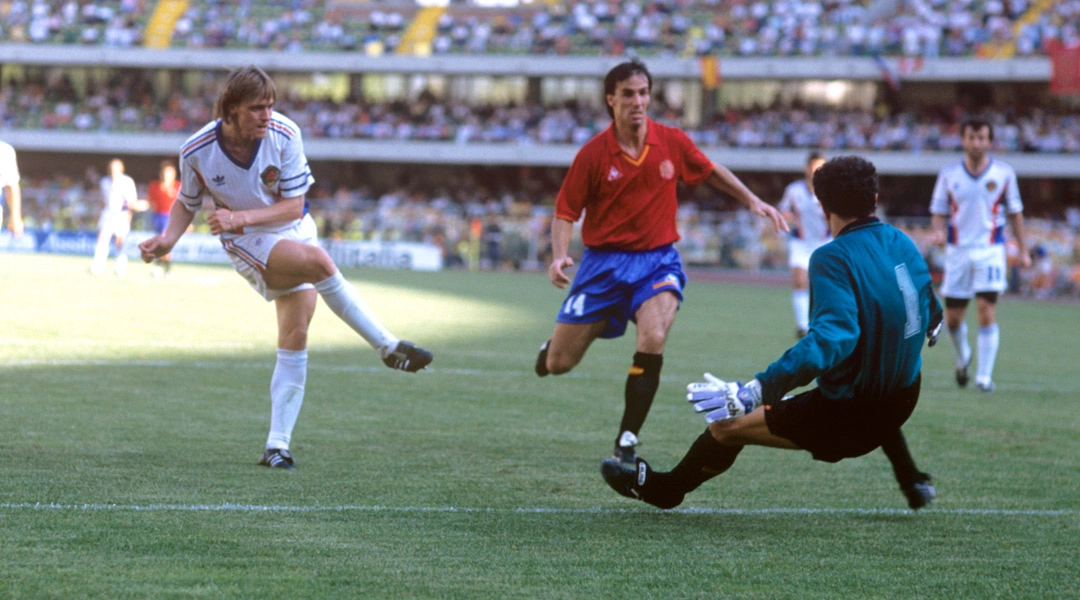
He was the coach of a supremely gifted Yugoslavia team that, after being blown away by a magnificent West Germany in their opening game, came back to light up the tournament with their technical football. They beat Spain 2-1 in an epic in Verona, before going out on penalties to Argentina in the quarter-final – having played 90 minutes with 10 men after the dismissal of Refik Sabanadzovic.
"The team was far, far better than the country," said Osim. "I'm not sure it's good to talk about it because football is football and life is life. Football is a pretty game, but it's not larger than life. It would be an illusion to make a lamentation about that generation of players, and not to talk about what happened afterwards.

"Lots of people have been killed. The country was destroyed. It's not fair for me to talk about the players and not to talk about what happened next. Sometimes there are things that are more important than football. One thing is sure: if the players were in charge instead of the politicians, nothing could ever be like this."

He ranks the game against Spain, when Dragan Stojkovic scored twice and played well enough to earn a move to Marseille, as the best in his time as national manager. "You see the result and you see a positive result, so automatically you think it's the best game of the tournament," he said.
"But also I think that game was special because Spain was always a football force. It was important in showing that we had the same number of good individuals as Spain. And it was the sort of game in which players could make sure they stood out from the crowd. Stojkovic did that, but even without that game he would have been a great player."
That set up the quarter-final against Diego Maradona's Argentina, and it was then that the political situation began to intrude. "That should have been the biggest game, but it was played at the wrong time, because we had a lot of other problems and the team could not concentrate.
"Srecko Katanec, who was a really, really important player for us, said 'Please, don't pick me' a few hours before the game because he had received a threat in his city. He was afraid to walk around in Ljubljana because of threats. I can understand that's not a nice position. How can he play? If he goes to play in Italy and his family stays in Ljubljana then they are under threat. I can't persuade anybody not to think about that."
And so Yugoslavia slipped out on penalties, and a squad that also included Robert Prosinecki, Davor Suker, Darko Pancev, Dejan Savicevic and Alen Boksic would never come together on the big stage again. They were expelled from Euro 92 as the war began, and by 1994 the federation had ceased to exist. The young team of 1990 remains frozen forever in time, an unsullied force of amazing but unrealised potential.
Others never seen again...
West Germany: They won the last tournament before reunification, but the expected domination of the European game never materialised.
USSR: As Mihail Gorbachev's reforms led to fragmentation, the USSR endured a limp final tournament, losing 2-0 to Romania and Argentina before beating Cameroon when they were already out.
Czechoslovakia: The goals of Tomas Skhuravy carried them to the quarter-final, since when the Czech Republic have carried their flame – until 2010, when Slovakia made their tournament bow.
