 Join The Club


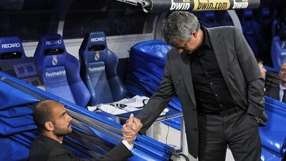
When the La Liga giants clash in their first leg at Real's Bernabeu stadium on Wednesday, the third of four Spanish "Clasicos" in 18 days, Barca's pensive, enigmatic manager, the Catalan Pep Guardiola, will again lock horns with outspoken Portuguese Jose Mourinho.
Sports psychologists and coaching experts say the pair, who inspire intense loyalty from their players, are adept at creating a training regime that gets the very best out of their hugely talented and expensive squads.
The main difference in their approaches is their behaviour away from the pitch, at news conferences and in interviews.

Mourinho, whose self-confidence is sometimes interpreted as arrogance, regularly goes on the attack, denouncing referees for alleged bias, criticising football authorities for not giving his players enough rest between games and clashing with rival coaches and even officials from his own club.
His strategy appears to be one of creating a siege mentality, where he is fighting to perform his duties and protect his players while having to cope with a high degree of adversity in various forms.
The softly-spoken Guardiola, by contrast, rarely criticises, is invariably polite and respectful towards opponents and rarely loses his cool in public.
"Guardiola's demeanour is that of a club coach, pensive, correct in his attitude, empathetic," Joaquin Dosil, an expert in sports psychology at the University of Vigo in northern Spain, told Reuters.
"Mourinho has the image of a coach who stretches the rules, aggressive, direct and ambitious," added Dosil, who has published a number of books on sports psychology.
"Both have similar day-to-day working methods in training, looking for dynamic sessions that help to push players to perform at their highest level."
CATALAN PRIDE
Mourinho, 48, was never a top-level professional and learned his trade as an assistant Barca coach under Bobby Robson and Louis van Gaal when the now 40-year-old Guardiola was a hugely influential player there in the 1990s.
After winning the Champions League with Porto in 2004, Mourinho led Inter Milan to the continental title last season, disposing of Barca in the semis, while Guardiola secured the Champions League in his first term in charge in 2009.
Juan Carlos Cubeiro, an expert in coaching and talent development and co-author of the book "Mourinho versus Guardiola", said Guardiola had successfully exploited Barca's status as a symbol of Catalan nationalism and pride.
Mourinho was better suited to Real's more international outlook, something which fits well with president Florentino Perez's goal of making the club, the world's richest by revenue, the reference point for global soccer, he added.
"Guardiola is able to tap in to the atmosphere around the club which is like a family-run company," Cubeiro told Reuters.
"Mourinho has cemented more the 'Florentino model', which is more international, and you can see this in the number of languages he speaks," he added.
