 Join The Club



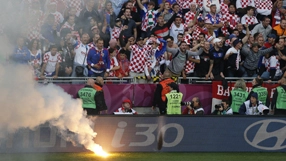
European football's governing body has charged Croatia's Football Federation (HNS) for racist chants and symbols displayed by the national team's fans during the Group C match against Italy in Poznan on Thursday.
FARE, an independent anti-discrimination and social inclusion network which works closely with UEFA to identify instances of racism at matches, said hundreds of Croatian fans had racially abused Italy striker Mario Balotelli.
UEFA is also investigating reports that a banana was thrown on to the pitch in the same game, and is looking into racist chanting during two other matches.

"We're very clear what we need; messages from the top, from the leaders of football to say, whatever the environment we're in, whatever the circumstances of where the tournament is being held, that there are some things that are just beyond the pale," FARE executive director Piara Powar told Reuters in a telephone interview.
"We've had that already from some people in UEFA but I think there is nothing like a message that comes from a sanction."
It is not the first time Croatia have landed in hot water with UEFA and world governing body FIFA for racist behaviour by their fans, having twice been fined in the last four years.
The Croatian federation reacted to the latest charge by condemning the chanting and urged UEFA "not to punish the national team".
Fears of racism on the terraces clouded the build-up to the Poland and Ukraine co-hosted tournament, the biggest sporting event to be held in eastern Europe since the end of communism.
Dutch players said they heard monkey chants directed at them during a training session in the southern Polish city of Krakow, two days before the continent's football showpiece started.
Czech Republic defender Theodor Gebre Selassie, the first black player to represent the Czech national team, told reporters he had "noticed" racist chants directed at him during his side's game with Russia.
Powar, whose organisation has two "international monitors" present at each Euro 2012 match to identify racist behaviour and far-right banners, said a number of sociological factors were behind the problem.
POTENT MIX
"A lot of things have come together to make quite a potent mix, some of which has led to violence, some to racism, extreme nationalism, some of it which has just led to hooligans, especially in Poland, wanting to prove that they are still top dogs," he said.
"In many ways I think coming to eastern Europe, bringing a big sporting tournament like this for the first time, in the modern era was always going to throw up challenges.
"We've been [working] in eastern and Central Europe for 10 years or more, we've known the evolution of the story out here. Some of the things that have gone on are a reflection of every day realities in the region."
Russia has been penalised for the displaying of "illicit" far-right banners by their fans in their first two games and Polish and Russian hooligans fought street battles before Tuesday's match in
