 Join The Club



But the former England manager Fabio Capello, who resigned in February, was not in the room.
It was a first sign, albeit tongue-in-cheek, of rising tensions ahead of Sunday's quarter-final in Kiev where Italy will play England.
Across the medieval squares and cobbled streets of Krakow, the phoney war, played out in televised opinions, radio comment, written words and silence, had begun.

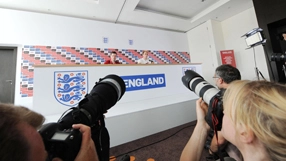
The Italian media corps were visiting the headquarters of their counterparts at the Football Association's (FA) England media centre on the first floor of Andel's Hotel.
It was, for them, a very strange experience.
The previous day, the English media had descended on the Italians' home from home, the Casa Azzurri, a warren of blue-walled corridors, espresso bars and leather sofas.
There, at the right hour of the day and often afterwards, pasta is offered to all visitors along with a warm welcome and open access to players and coaches at news conferences.
The Italians also provide the services of an official translator who repeats all questions and answers in English, ensuring visitors are treated with respect as well as offered traditional hospitality.
But when Italy's media corps, accustomed to life in the converted Rotunda Cultural Centre overlooking the famous field of Blonia, tramped in the heat to visit England, it was all very different.
Where there were smiling 'ragazze' at the door, there were men in uniform. Where there are plates of pasta, there were Polish hotel canapes and where there is 'liberta' (freedom), there are chains - at least hypothetically - of the sort that John Milton opposed as he led calls for freedom of the press, in England, four centuries ago.
NOBODY AVAILABLE
Worse still, the English media team had nobody available to speak Italian, let alone translate.
Even before goalkeeper Joe Hart sat down to begin proceedings, a rumour began to spread.
Battle-hardened Italian reporters, unused to being told how to do their jobs, were concerned by a suggestion that because of an official embargo their reports would have to be delayed for 24 hours.
When a member of the FA staff made a swift announcement, in English, to confirm their worst fears, there was consternation.
It was never quite uproar but the rising sound of confusion and disbelief in a room filled with at least 200 representatives of the media was tangible.
News management, by using embargoes, is used by the English media to control the timing of stories and thus to favour the needs of the London daily papers. It is a uniquely English phenomenon at major football tournaments.
After an interval, as if a theatrical production was re-starting, another English FA staff member appeared, this time with an Italian reporter, Stefano Boldrini of Gazzetta dello Sport, Italy's leading sports daily.
Speaking Italian, he confirmed the request that any stories to be derived from the group interview with a second Engl
