 Join The Club


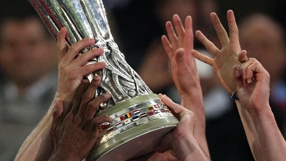
More than 10 tortuous months, two disqualifications and 202 matches later, the Europa League reaches its climax on Wednesday with a meeting between two Spanish sides, both coached by Argentines, in Romania.
Finalists Athletic Bilbao and Atletico Madrid, the 2010 winners, were both delighted to be in Europe's second-string club competition but the same could not be said for English champions United.
Manager Sir Alex Ferguson said that taking part was a "punishment" for his side, a remark which forced UEFA president Michel Platini to leap to the defence of the Champions League's less glamorous sibling.

"The world does not revolve around England, I like England a lot, it's football is fantastic, it's supporters are wonderful but you shouldn't criticise the Europa League just because you've played in three Champions League finals," he retorted.
"The Europa League is a brilliant competition. I know Mr Ferguson would have preferred to be in the Champions League but so would many clubs who don't have that possibility."
The majority of European fans would probably place themselves somewhere in between English indifference to the competition and Platini's unbridled enthusiasm, though most would struggle to unravel its bewildering complexities.
Put simply, the Europa League is the rebranded version of the former UEFA Cup which itself started out as the Inter Cities Fairs Cup and absorbed the old European Cup Winners Cup somewhere along the line.
The Blizzard magazine suggested recently that the tournament ought to be named "The Second-Tier Distribution of Teams as Apportioned by Mathematical Coefficients Cup" to give fans a real idea of what it truly represents.
The format is baffling enough, featuring four qualifying rounds of two-leg ties, a group stage with a round-robin mini-league format, four more phases of knockout ties and a one-off final in neutral territory.
Teams can qualify by winning their domestic Cup, finishing anywhere between second and sixth in their league, getting knocked out of the Champions League or simply by being nice and winning one of three places allocated to according to UEFA's fair play rankings.
They enter the fray at any point between the first qualifying round in June and the round-of-32 the following February, depending on the ranking of their country's league in UEFA's highly complex system of coefficients.
A total of 193 teams, from 52 of UEFA's member associations, took part this season of which 33 parachuted in after elimination at various stages of the Champions League. Unlucky Liechtenstein is not represented as it does not have its own league or Cup.
DEEPEST KAZAKHSTAN
The first qualifying round saw the part-timers of Faroe Islands outfit NSI, whose stadium holds 500 people and was deemed not up to UEFA standards, meet the Premier League professionals of Fulham, who qualified via the fair play route.
Other early entrants included Kazakhstan's Irtysh Pavlodar, whose stadium is closer to Mongolia and China
