
 Join The Club



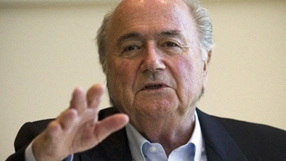
Blatter began a week in which he should be re-elected as president for a fourth term in combative mood, berating media for their lack of manners and giving Qatar his public backing.
FIFA General Secretary Jerome Valcke earlier issued a statement denying he meant to suggest anything corrupt about the Qatar bid for 2022.
While all the talk outside FIFA House has been of a drip-feed of corruption allegations creating the worst crisis the game has faced, Blatter said his organisation was merely experiencing local difficulties they could solve internally.

It did not feel that way earlier in the day when CONCACAF president Jack Warner made public an email in which Valcke wondered if Mohamed bin Hammam, who planned to stand against Blatter, thought he could buy the presidency as Qatar "bought" the World Cup.
Qatar issued a flat denial of any wrongdoing and Valcke later said he only meant that the Gulf state's financial muscle meant they were able to mount an effective lobbying campaign.
Qatar received further support from Blatter at his dramatic evening news conference, with the president saying FIFA had received no evidence that there were issues with the process to choose the 2018 and 2022 World Cups.
Blatter, the 75-year-old Swiss who has run football's world governing body since 1998 and seen it grow wealthy on the sale of TV rights and sponsorship, will run unopposed in Wednesday's election following Bin Hammam's withdrawal on Sunday.
That came hours before the Qatari was suspended along with Warner over an allegation that Bin Hammam paid Caribbean delegates $40,000 to vote for him instead of Blatter.
Blatter said he regretted the recent "damaging" allegations but said the problems could be solved in-house.
"Football is not in a crisis," said Blatter. "Football is in some difficulties and they will be solved inside our family."
FIFA sponsors also reacted to the controversy.
"Adidas has a very long and successful partnership with FIFA, which we are also looking forward to continue," an Adidas spokesman said.
"Having said that, the negative tonality of the public debate surrounding FIFA is neither good for football nor for FIFA and its partners."
Turning to other allegations, Blatter said there was no case to answer against four FIFA Executive Committee members accused of corruption during a British parliamentary hearing this month.
Blatter also said there had been no evidence from the Sunday Times newspaper over a claim that Issa Hayatou and Jacques Anouma had been paid to vote for Qatar's 2022 World Cup bid.
Last November, executive committee members Reynald Temarii and Amos Adamu were banned for agreeing to sell their votes to undercover newspaper reporters, the first in what turned out to be a wave of allegations.
Blatter, cleared by a FIFA Ethics Committee on Sunday, distanced himself from his executive committee, whose members are elected by their respective confederations rather than from within FIFA itself.
FORMER CHALLENGES
Blatter has faced down challenges to his position before, notably in 2002 when secretary general Michel Zen-Ruffinen claimed his 1998 election victory was based on bribery and corruption.
Blatter subsequently won re-election and Zen-Ruffinen was soon out of a job.
Five years later, he was elected unopposed for a third term.
While the last six months have been the most turbulent of his reign, he is on course to get the fourth term he said during the campaign would be his last.
The recent problems stem from last year's World Cup votes, when Russia saw off opposit

