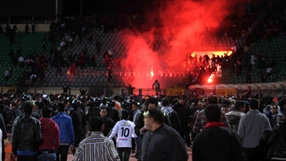
74 killed following Egypt pitch invasion
Reuters - Thursday 02 February 2012, 00:28
Seventy four
people were killed and at least 1,000 injured on Wednesday when
Egyptian football fans staged a pitch invasion in the city of
Port Said, in what a deputy minister called the biggest disaster
in the nation's football history.
Angry politicians decried a lack of security at the match
between Port Said team Al-Masry and Cairo's Al Ahli, Egypt's
most successful club, and blamed the nation's leaders for
allowing - or even causing - the tragedy.
"Down with military rule," thousands of Egyptians chanted at
the main train station Cairo where they awaited the return of
fans, quickly turning the latest upsurge in violence into a
political demonstration against army rule.
"The people want the execution of the field marshal," they
shouted, turning on the ruler of the miltiary council, Field
Marshal Mohamed Hussein Tantawi, who tried to assuage anger by
vowing to find the culprits in a phone call to a TV channel.

The pitch invasion provoked panic among the crowd as rival
fans fought, with most of the deaths among people who were
trampled in the crush of the panicking crowd or who fell or were
thrown from terraces, witnesses and health workers said.
"I saw people holding machetes and knives. Some were hit
with these weapons, other victims were flung from their seats,
while the invasion happened," Usama El Tafahni, a journalist in
Port Said who attended the match, told Reuters.
Many of the Al Ahli fans involved were 'ultras', dedicated
supporters of the team with years of experience confronting
police at football matches and who played a leading role in
hitting back at heavy-handed security forces during the uprising
that toppled President Hosni Mubarak.
The have been seen as at the vanguard of subsequent clashes
with police and the army in violence that followed Mubarak's
ouster, and were also among those who protested outside the
Israeli embassy and tore down walls that the army erected to
protect the embassy.
Tantawi pledged that the army's plan to hand over power to
civilians would not be derailed.
"Egypt will be stable. We have a roadmap to transfer power
to elected civilians. If anyone is plotting instability in Egypt
they will not succeed," he told Al Ahli's sports channel during
his phone-in.
Interior Minister Mohamed Ibrahim said 47 people had been
arrested following the unrest and state television quoted
Tantawi as saying a fact-finding committee would investigate the
violence.
Deputy Health Minister Hesham Sheiha told state television:
"This is unfortunate and deeply saddening. It is the biggest
disaster in Egypt's football history."
"PRE-PLANNED EVENTS"
Some enraged Egyptian politicians accused officials still in
their jobs after the fall of Mubarak of complicity in the
tragedy, or at least of allowing a security vacuum in which
violence has flourished since last year's revolution.
"The events in Port Said were pre-planned and are a message
from the remnants of the regime. There are those who want the
bloodshed to continue," said Essam el-Erian, a member of
parliament of the Muslim Brotherhood's Freedom and Justice Party
which came out on top in recent parliamentary election.
The violence flared after the match between Al-Masry and Al
Ahli, whose fans have a history of fierce rivalry.
Witnesses
said fighting began after Ahli fans unfurled banners insulting
Port Said and one descended to the pitch carrying an iron bar at
the end of the match, which Al-Masry won 3-1.
Al-Masry fans reacted by pouring onto the pitch and
attacking Ahli players before turning to the terraces to attack
rival supporters.
Many fans died in a subsequent stampede, while some were
flung off their seats onto the pitch and were killed by the
fall. At the height of the disturbances, rioting fans fired
flares straight into the stands.
Hospitals throughout the Suez Canal zone were put on a state
of alert and dozens of ambulances rushed to Port Said from the
Canal cities of Ismailia and Suez, said an official in the
zone's local ambulance service.
Tantawi ordered two helicopters be sent to Port Said to fly
out some of the visiting Al Ahli team and its fans,
military sources said. The helicopters would transfer the
injured to military hospitals, the sources said.
Egypt's top Muslim cleric called the events a massacre that
violated the words and teachings of Islam.
Another match in Cairo was halted by the referee after
receiving news of the violence in Port Said, prompting fans to
set parts of the stadium on fire, television footage showed.
"THIS IS WAR"
Live television coverage showed fans running onto the field
and chasing Al Ahli players. A small group of riot police formed
a corridor to try to protect the players, but they appeared
overwhelmed and fans were still able to kick and punch the
players as they fled.
"This is not football. This is a war and people are dying in
front of us. There is no movement and no security and no
ambulances," Al Ahli player Mohamed Abo Treika told his club's
television channel.
"I call for the premier league to be cancelled. This is
horrible situation and today can never be forgotten."
State television reported that Egypt's football federation
had indefinitely suspended premier league matches.
FIFA President Sepp Blatter
expressed his shock at the tragedy. "This is a black day for
football. Such a catastrophic situation is unimaginable and
should not happen," he said in a statement.
Albadry Farghali, a member of parliament for Port Said,
accused officials and security forces of allowing the disaster,
saying they still had ties to the government of Mubarak, who was
overthrown a year ago.
"The security forces did this or allowed it to happen. The
men of Mubarak are still ruling. The head of the regime has
fallen but all his men are still in their positions," he
screamed in a telephone call to live television.
"Where is the security? Where is the government?"
A number of policemen were among the dead, a medical source
and witnesses said.
Thursday marks the first anniversary of clashes on Tahrir
Square when Mubarak supporters on camelback charged
pro-democracy demonstrators, and fought with the ultras.
Online activists saw a connection with the ultras.
"The police and army [did not move] a muscle to prevent the
bloodshed," activist Sohair Riad wrote on Facebook.
"Their
silence screams complicity. This is a collective assassination
of a group that continues to support the revolution and
struggles against military rule."