Incensed Egyptians stage protests after deaths
Reuters - Thursday 02 February 2012, 18:31
Egyptians incensed by
the deaths of 74 people in football violence clashed with security
forces on Thursday during protests against the army-led
government for failing to prevent the deadliest incident since
the overthrow of Hosni Mubarak.
Security forces fired tear gas at demonstrators near the
headquarters of the Interior Ministry in Cairo, prompting
hundreds to flee. "Down down with military rule," they chanted,
many holding aloft pictures of those killed.
State media reported scuffles between members of the
security forces and demonstrators who included hardcore fans known for confronting the police and who were on the
frontlines of protests against the state in the last year.
Earlier, a Reuters witness saw a dozen masked youths remove
a barbed wire barrier blocking one route to the Interior
Ministry and then throwing stones at riot police standing guard.

The Interior Ministry said in a statement that security
forces were protecting the building after protesters cut the
wire barricades and climbed over concrete walls in an attempt to
reach the building.
As tear gas cannisters flew, witnesses saw unconscious
people being ferried away from the area on motorbikes and
ambulances raced to the scene.
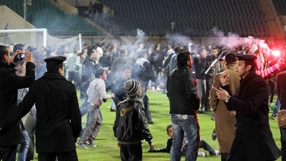
The incident at the stadium in Port Said on Wednesday night
was Egypt's worst ever football disaster. Bodies were unloaded
from a train at Cairo's main train station, covered by blankets.
"Where is my son?" screamed Fatma Kamal, whose frantic phone
calls seeking news of her 18-year-old had gone unanswered. "To
hell with the football match... give me back my boy."
At least 1,000 people were injured in the violence when fans invaded the pitch after local team Al-Masry beat
Cairo-based Al Ahli, the most successful club in Africa.
Hundreds of al-Masry supporters surged across the pitch to
the visitors' end and panicked Ahli fans dashed for the exit.
But the steel doors were bolted shut and dozens were crushed to
death in the stampede, witnesses said.
"I suddenly heard a commotion and ran to the door to find
people getting crushed... with their legs stuck in between the
iron bars," said Ahmed Moustafa Ali, an electrician employed at
the stadium who witnessed the incident.
"The doors were locked because the rules stipulate that we
don't let fans leave at the same time," he said.
The gate lay broken outside the ground on Thursday. Under it
lay a pool of blood and shoes were scattered around. The front
page of one newspaper announced "A Massacre in Port Said."
The incident has triggered fresh criticism of the ruling
military council, which has pledged to hand power to an elected
president by the end of June. The head of the council said any
attempts to cause instability would not succeed.
In the newly-elected parliament, MPs including the Islamists
who control some 70 percent of the chamber demanded the
government be held to account during an emergency session
attended by Prime Minister Kamal al-Ganzouri.
Addressing angry lawmakers, Ganzouri said senior security
chiefs in Port Said and the city's governor had been suspended
and the football federation's board had been sacked. But he
disappointed those seeking tougher steps, such as firing the
interior minister.
Some MPs echoed the suspicion of many Egyptians that the
incident was the work of remnants of the Mubarak administration
trying to derail reform.
INQUIRY
The MPs voted to launch an investigation into what happened
and lodge a formal complaint with the military against Interior
Minister Mohamed Ibrahim, accusing him of negligence.
The Supreme Council of the Armed Forces, headed by Mubarak's
long-time defence minister, vowed to track down the culprits and
declared three days of national mourning.
"Egypt will be stable. We have a roadmap to transfer power
to elected civilians. If anyone is plotting instability in Egypt
they will not succeed," Field Marshal Mohamed Hussein Tantawi,
head of the military council, told Al Ahli's TV channel.
While the generals have vowed to steer Egypt towards
democracy, they are seen by critics as an extension of Mubarak's
rule and an obstacle to real reform. Repeated protests in the
last two weeks have urged them to step down right away.
"The military council lost its legitimacy today given the
blood that has been shed," Mustafa Naggar, an MP from the
Justice Party, said in parliament.
Tantawi voiced deep regret over the incident and offered
condolences to the families of the victims.
It did little to assuage the anger of fans, who, like many
Egyptians, are furious that Egypt is still plagued by
lawlessness and violence almost a year after Mubarak was driven
out.
"The people want the execution of the field marshal," fans
chanted at the Cairo rail station. "We will secure their rights,
or die like them," they said as bodies were unloaded from the
trains.
In Egypt's second city of Alexandria, thousands echoed their
cry.
The post-match pitch invasion provoked panic among the crowd
as rival fans fought. Most of the deaths were among people who
were trampled in the crush of the panicking crowd or who fell or
were thrown from terraces, witnesses and health workers said.
"The rush caused a stampede, people were pushing each other
against the metal door and stepping on each other," said one
witness who attended the match, 23-year-old Ossama El-Zayat.
"We saw riot police firing shots in the air, and then
everyone got scared and kept pushing against the locked door. We
didn't know whether police were firing live rounds or not.
People were crying and dying," he said.
Some saw the violence as orchestrated to target the 'Ultras', Al Ahli fans whose experience confronting police at football matches was turned with devastating effect against
Mubarak's heavy-handed security forces in the uprising.
They played a significant role in defending Cairo's Tahrir
Square, the heart of the uprising against Mubarak, when men on
camels and horses charged protesters last year. Thursday is the
anniversary of the February 2 camel charge.
Yet many Egyptians still see the army as the only guarantor
of security. When one activist in a group outside a hospital
accused the army of sowing chaos, a man chimed in blaming the
youths: "Security has to return to the streets. Enough with all
those protests that caused this security vacuum," he yelled.
'THUGS'
Some blamed the violence on "thugs" - the hired hands or
plain clothes police officers of Mubarak's era who would often
emerge from police lines to crush dissent to his rule.
"Unknown groups came between the fans and they were the ones
that started the chaos. I was at the match and I saw that the
group that did this is not from Port Said," said Farouk Ibrahim.
"They were thugs, like the thugs the National Democratic
Party used in elections," he said, referring to Mubarak's former
party and the polls that were routinely rigged in its favour.
The two teams, Al-Masry and Al Ahli, have a history
of fierce rivalry. Witnesses said fighting began after Ahli fans
unfurled banners insulting Port Said and one descended to the
pitch carrying an iron bar at the end of the match.
"I saw people holding machetes and knives. Some were hit
with these weapons, other victims were flung from their seats,
while the invasion happened," Usama El Tafahni, a journalist in
Port Said who attended the match, told Reuters.
Many fans died in the subsequent stampede, while some were
flung off their seats onto the pitch and were killed by the
fall.